Category Archives: Spiritual Stuff

The Power to Laugh

Here is today’s entry in Reflections for Lent, a free e-book available to Blue Room newsletter subscribers. It’s not too late to get yours! Subscribe here.
The Power to Laugh

Romans 5:1-5: “Hope does not disappoint us…”

Professor Tom Long tells a story about the civil rights movement, how the Ku Klux Klan would often march down Auburn Avenue, the African-American center of Atlanta. Each time the residents would see the Klan coming, they would draw their shades, lock their doors, and cower in their homes until that parade of evil was over.

But then, in the fullness of time, civil rights started to take hold. Just when the tide was starting to turn, when people could finally see justice on the horizon, the Klan marched once again down Auburn Avenue. But this time the people lifted their window shades, threw open their doors, stood on the sidewalk, and laughed, and laughed, and laughed…

And the Klan never marched down Auburn Avenue again.

Maybe you’ve known people who’ve worked tirelessly for justice and peace, sometimes over a period of decades. The ones who persevere are the ones who bring to their work a sense of lightness and an appreciation for life’s little absurdities. These folks are not beaten down by the discouragement that change comes only in tiny increments, if at all. Instead, they are almost fizzy in their joy. Such is the nature of hope.

Lent has a reputation for being a grim season. Certainly the cross is no laughing matter. But even with its vigorous self-examination in the shadow of the cross, we can’t forget that Lent is moving in the direction of redemption. Let us be detectives for joy in a world that can often be drab and colorless.

Loving Creator, help me take your call to discipleship seriously… which sometimes means taking myself lightly.

~

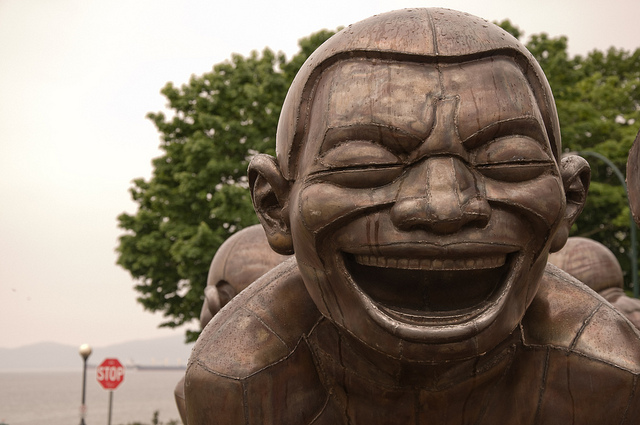
Photo credit: “Amazing Laughter” sculpture by Yue Minjun, photo by Matthew Grapengeiser and used via creative commons license.

Monday Runday: Better Than Church? Exercise as a Spiritual Experience

static1.squarespace

Last week I caught Tom Ashbrook’s show On Point (via podcast). He was talking about the so-called “boutique fitness” trend—exercise classes that promise not only a hard workout but also strong community, and in some cases spiritual enlightenment. The panelists discussed Soul Cycle, CrossFit and other fitness fads.

Unfortunately, the cost of these classes got conflated with the larger issue of spiritual impact. Many of these programs are very expensive and exclusive. People can spend thousands of dollars a year on these classes, and many listeners (and commenters) criticized this trend as yet another symptom of the narcissism run rampant in our culture. I agree, it seems icky to spend THAT much money on a fitness-related pursuit. Especially since there’s nothing inherently costly about many of these programs. A barre class, for example, requires a trained instructor, a room, and a couple of barres. A listener called in from Nashville who takes similar courses at her local rec center for three bucks a class.

That said, I live in an expensive area of the country, with lots of friends who belong to gyms and yoga studios, and I’m sure the price tag would make people balk who live in cities with a lower cost of living. I go to the relatively low-rent Fairfax County RECenters, which don’t require a monthly fee, but I’m sure people could look sideways at the money I spend on races and running gear. The economic thing is relative. But I don’t agree with the sentiment that “It’s their money so who cares?” What we spend money on as a culture says something about our values, and it’s all worth examining.

But setting aside the economics of these classes, the discussion of spiritual impact and community was a good one. I ran for many years before I joined a running group, and it’s brought so much to my life, I sometimes kick myself for waiting as long as I did. (Kicking oneself isn’t good cross-training, by the way.)

A few people brought up the physical, mental and spiritual boost you get from working out—the runners’ high, if you will. It got me thinking about my current religious tradition (Presbyterian). At least here in the U.S., we’re by and large a reserved bunch in worship. We sing hymns and pray silently and read creeds in unison. I’d say our worship strives to be joyfully reverent, but ours is not an ecstatic, charismatic tradition. Yet perhaps there’s something in the human psyche that craves catharsis. Are people feeling drawn to extreme sports and communal workout experiences because we want a safe, socially-sanctioned way to experience these big feelings together? I don’t know.

Many of the panelists mentioned how devoted people are to things like CrossFit and SoulCycle, even calling their devotion “religious.” But there are (still) things religion provides that these other things do not. A story, for one—a larger narrative in which to place yourself. An ethical sense of the world. A sense of service. A connection to something larger than yourself. Now, my running friends and I get into some deep stuff while we’re pounding out the miles. We share inspirational stories. There’s a sense of connection to the spirit of the sport. But there’s not a larger common mythology guiding our lives.

On the other hand, I know I’ve been slower to find a church home for our family because I get many spiritual needs met through my running community (which I connect with online and in person). Not all spiritual needs, but many:

  • Accountability: What gets me out of bed in the 4:00 hour on a cold morning is knowing other people will be waiting for me. But it’s not just running accountability-we check up on one another, ask about our families, chide one another when we’re not taking care of ourselves, etc.
  • Vulnerability: There’s nothing quite like putting your body through its paces while other people are around. I know folks who’ve gotten sick on group runs, or had a bathroom emergency and needed help from a fellow runner. A good race, or a bad one, brings up big unbidden feelings. Do our religious communities give us opportunities to be vulnerable with one another in similar ways? How?
  • Mentorship: I’m a devoted middle-of-the-packer when it comes to running, and I have a lot to learn from people who’ve been at this longer (and who are more accomplished). I also think I have something to offer people who are new at this. How well do religious communities do the official and unofficial mentorship thing?
  • Service: This is something most religious communities do well, but you can find plenty of opportunities to give back apart from the church. The running group I’m in does canned food drives, coat drives and the like. Religious communities also often (but not always) engage the larger issues of justice that community groups may not.

Finally, the show featured a Harvard Divinity School student named Angie Thurston who co-wrote a paper called How We Gather. The paper argues that people are finding spiritual fulfillment in alternate forms of community, from Harry Potter fan groups to running groups. The church would do well to pay attention to this. I’m looking forward to delving into this paper.

Does exercise provide a spiritual outlet for you? How about community? What’s your experience?

Speaking of opportunities to deepen your spiritual life-I’m giving away a free resource in February. Get the details!

~

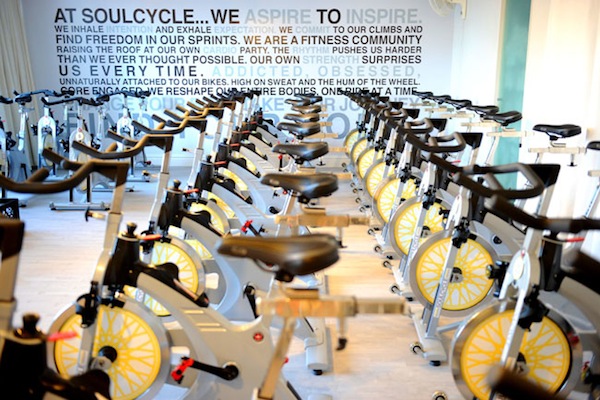
Image is of a SoulCycle class.

The Peace of Baked Things… A Poem, Plus Bonus Muffin Recipe

3283331121_2ecd8d73c9_z

What do you do when you’re discouraged about the state of the world?

I bake muffins. And jot poems.

With apologies to Wendell Berry’s poem The Peace of Wild Things:

The Peace of Baked Things

When despair for the world grows in me
and I can’t sleep at the least sound
in fear of what my life and my children’s lives may be,
I creep down to the kitchen, socks on cold wood.
A clatter of bowls, hiss of spray on pans,
and a pillow of flour.
Leavening a perfect mound, whiter than white.
Follow directions and all will be well.

Now the liquid: thick buttermilk;
melted butter, a risen sun grinning wickedly from its bowl;
and an egg-the cracked one, from when my son fumbled the carton.
I whisk, wincing at the memory of his frustrated tears.

Then a pause over the two bowls.
Master over this one thing, I can suspend time indefinitely,
stop the culinary combustion for as long as I wish.

But such sovereignty is foolish.
The mess is meant to be mixed,
folded, scooped, baked,
and warmed-
for the teen who wakes herself before dawn,
the long-haired girl with the cat-ear headband,
the boy who broke the eggs.

~

Brown Sugar Butter Pecan Muffins (or loaf)

adapted from Real Easy Recipes

INGREDIENTS
2-1/4 cups sifted all-purpose flour
2 teaspoons baking powder
1/2 teaspoon baking soda
1/2 teaspoon salt
1/2 teaspoon cinnamon
1/4 teaspoon nutmeg
1 cup light brown sugar, packed
1 egg, beaten
1 cup buttermilk
2 tablespoons melted butter
1 cup chopped pecans

INSTRUCTIONS

  1. Sift together the flour, baking powder, soda, salt, and spices; blend in brown sugar.
    Combine egg, buttermilk, and butter; add to flour mixture, stirring to blend well. Stir in chopped nuts.
  2. Scoop batter into 12 greased muffin tins (or a greased and floured 9-by-5-inch loaf pan). Bake at 350 degrees for 15-20 minutes (45 to 50 minutes for loaf) or until a toothpick inserted in center comes out clean.

~

Psst… my 2015-2016 workbook/playbook is still available for a couple more days.
Find out more.
Get the workbook now.

Photo Credit: “baking” by Ballookey Klugeypop, Flickr, creative commons license.

Improv: It’s Not Just for Comedy Anymore

2832131751_ed18ffab4e_z

(News flash: it never was.)

What happens when you give scientists improv lessons?

That’s what New York’s Stony Brook University is trying to figure out through Improvisation for Scientists, a class spearheaded by a team of folks including actor Alan Alda.

They aren’t trying to find the next Amy Poehler. Instead the goal is to teach a mindset and a series of communication skills to budding STEM and medical students. Alda tells about a science student whose perspective shifted as a result of the class. Rather than looking at a set of data and feeling it was his job to make sense of it-to control it by explaining it-he “lets the data talk to him.” Just as a partner on stage speaks to you, and it’s your job to pay attention so you can respond.

Improv is a process of discovery, much like the pursuit of scientific knowledge itself. But most of life is an improvisation, I’m convinced.

In fact, I’m very grateful to have received a grant from the Louisville Institute to explore this topic. I’ll be taking improv classes, here in DC and in Chicago at Second City, and I’ll be interviewing people for a podcast that will roll out next year. Stay tuned for more on that work!

I’ve already studied and written a bit about improv, and have led events on improv and the spiritual life. Sometimes people balk at the topic because they think my goal is to get people up on stage, or to be funny on command. That’s not it at all.

As an example, a medical student in the Stony Brook program used his improv training from a game called ‘Mirror Exercise’ to better communicate with a patient:

He had to tell her that her cancer had metastasized and she had only two weeks left to live. He was terrified going into the conversation.

At first the woman had no reaction at all to the news. He had the feeling she didn’t understand what was happening, so he decided to use some of his improv training.

“He said, ‘I sat down with her and we held hands. … I told her in the simplest possible way what was happening. I didn’t use any three-syllable words. I didn’t use the word ‘metastasis,’ I didn’t use the word ‘prognosis.’ I just tried to be simple and slow because I knew that there was a pacing to the way that you could hear this information.’ And he said ‘For the first time, the woman started to cry.’ And when she cried, it made him cry, and then when he cried she had a question,” [the student] says. “He said, ‘What I felt happened was that I was able to help her understand how to understand the end of her life. And she was able to help me understand how to be a better doctor.’”

Recently I was talking to a woman in charge of programming for a congregation-we’re trying to figure out whether I might come and lead some events there. I was explaining this improv stuff and launched into my standard speech about how improv isn’t about performance for me-it’s about learning to listen to your intuition, to take risks, to pay attention to what’s going on around you. Suddenly the woman said, “Oh, I know exactly what you’re talking about.” She told me about a young woman in her life who struggles with OCD. Her doctor “prescribed” improv lessons as one aspect of her treatment and it’s had a tremendous positive impact.

This is powerful stuff, folks.

And for the record: it scares me. It scares me because it’s powerful, and because it’s fundamentally out of my control. I joke sometimes that when I write the book on this it’ll be called Improv for Control Freaks, because that’s where I live and where a lot of us live.

For me, improv is wrapped up in the spiritual practice of letting go.

I can’t wait.

~

Reminder: Sign up to receive Gate of the Year, a free workbook/playbook to help you do a review of 2015 and set intentions and visions for 2016. Learn more here. Sign up here.

~

Image: 24h Contact Improvisation Jam by David Olivari through Flickr, Creative Commons License.

Free Stuff for New-Year’s Nerds and Other Thoughtful People

This just went out to my email list. If you, my blog readers, would like to receive the free workbook too, please sign up for my email newsletter. Quick and easy!

~

Dear friends,

Each December or early January, I like to take some time to reflect on the previous year and think about the year to come. This sometimes takes a quick hour or two, but when I have time, I give it a half day or more. (Often there’s lunch, a museum or a good popcorn flick involved too.) I celebrate what asks to be celebrated, release what needs to be let go, and set some intentions and hopes for the coming year.

What can I say… I find the rollover to a new year completely irresistible! Add a January 2 birthday to the mix, and the time is ripe for taking stock. But I’ve learned that many of you like to do something similar.

One friend puts together a fun survey for the family to complete, chronicling important events, favorites, and hopes for the year to come. Then they read the answers the following year and take a new survey. It’s like a revolving time capsule.

Another woman goes away to her family’s farm and lights a bonfire that she feeds all night with brush from the surrounding fields. This practice has become a metaphor for purging the negative stuff from the previous year.

Another man I know goes outside at 11:45 pm on New Year’s Eve and reflects on the year past. At midnight, he spends about 15 minutes offering hopes for the upcoming year.

I’ve done my yearly review in a variety of ways, using a variety of tools I’ve cobbled together over a long time. This year, I’ve decided to come up with my own process, and it’s been an unexpected blast to put together. There’s fun stuff, thought-provoking questions, a little fill in the blank, places to doodle…

It’s like a Choose Your Own Adventure of yearly review.

Well, it snowballed into a little “kit” I’ve decided to make available to you: my friends, my readers, the folks who’ve companioned me and one another on the journey.

I’m calling it
The Gate of the Year:
2015, 2016 and Beyond.

The name refers to my favorite New Year’s quote. (Yes, I have a favorite New Year’s quote. I told you I was hard core.)

Free Stuff for New Year’s Nerds

Do you do a yearly review? The Gate of the Year can be a great companion for your own practice. If you don’t normally do such reflection, I offer it to you for free, with no strings attached. Try it. Share it. Complete the pages you like and leave the rest. Jump around. Revisit it throughout the year for further exploration. Make it yours. Just as I hope you’ll make 2016 yours!

You’ll receive access to a PDF of The Gate of the Year in your next Blue Room email. You don’t have to do a thing to receive it (and are under no obligation to download it)… but if you know someone who would appreciate this little resource, encourage them to sign up so they don’t miss out. Here’s the link to sign up.

Advent Blessings,
MaryAnn

UPDATE: A couple of questions have come up since I first posted this:

When will this be ready? It was sent on December 29. But if you subscribe you will still get access.

If I subscribe to your blog via email, will I receive this resource through those messages? Unfortunately not. Many of you receive blog updates via email-when I post here, you get an email through WordPress. But the email newsletter is different—it’s sent twice a month and contains extra content, links, etc. that I don’t put on the blog. So if you want “Gate of the Year” you need to subscribe to the email newsletter. It goes out through MailChimp, which provides one-click unsubscribe if you find it’s not what you’re looking for.