First of all: new author website! Woohoo! Thanks to the folks at Paraclete Web Design for their great work, prompt service, and good humor. There will be a number of kinks to work out in the days to come, but how fun to have some new digs!
Away we go:
~
The Saddest Map in America - The Dish
Looking for love in all the wrong places? The most popular places mentioned in Craig’s List “missed connections” feature, compiled by state:
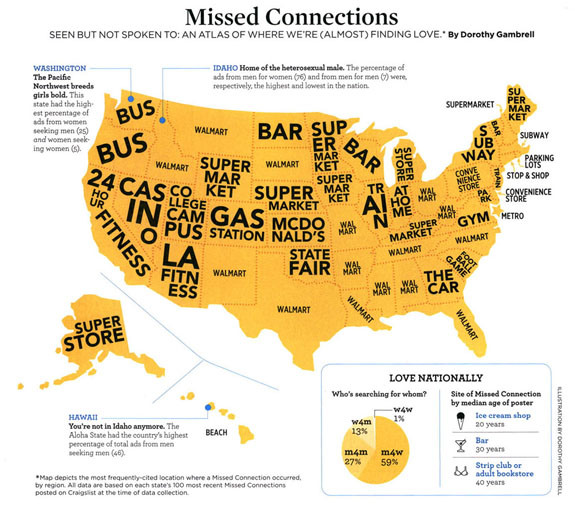
I don’t know what’s more awesome: that Wal-Mart appears so many times, or that Oklahomans are looking for love at the state fair.
~
Interview with Edward O. Wilson: The Origin of Morals - Spiegel
He’s changed his position on kin selection as it relates to evolution, favoring group selection instead:
During the 1970s, I was one of the main proponents of kin selection theory. And at first the idea sounds very reasonable. So for example, if I favored you because you were my brother and therefore we share one half of our genes, then I could sacrifice a lot for you. I could give up my chance to have children in order to get you through college and have a big family. The problem is: If you think it through, kin selection doesn’t explain anything. Instead, I came to the conclusion that selection operates on multiple levels. On one hand, you have normal Darwinian selection going on all the time, where individuals compete with each other. In addition, however, these individuals now form groups. They are staying together, and consequently it is group versus group.
I’m no scientist, but the tribal thing makes sense. There are new studies out about how liberals and conservatives over-exaggerate the characteristics of the other.
And this phrase was new to me:
“Humans,” the saying goes, “have Paleolithic emotions, medieval institutions and god-like technology”.
~
When the Children Make Us Laugh - Worshiping with Children
She is sitting on the steps with the pastor who asks a question. She offers what seems like a perfectly sensible answer and the whole congregation laughs. In that moment one of two things happens, either a comedian is born or a child feels humiliated. When a comedian is born, he often uses the children’s time to practice his new-found vocation, generally with beginner comedian results. He may even compete with the pastor for the attention of the congregation – especially if mom or dad is the pastor. The results can embarrass everyone – except probably the young comedian. But if the child who drew laughter feels humiliated, she often decides the conversations on the steps are dangerous.
There is surely middle ground here between a fledgling comedian and abject humiliation. But laughing at children when they are being serious is a major issue with me. It’s fine to share delight with one another, regardless of age. But I felt disrespected as a child when I made an earnest comment and adults laughed. Some ideas in this article about how to handle this in worship.
~
It’s Absurd - Bromleigh McCleneghan
During the Oscars, the Onion posted a vile tweet about child actress Quvenzhané Wallis. Bromleigh’s take on the incident is one of my favorites. She also has the best “About” page I think I’ve ever read in all my years of blogging.
~
Trust and Society - Bruce Schneier, The Montreal Review
This past weekend during book group at Tiny, we were discussing the Harry Potter series. I remarked that both Harry Potter and The Hunger Games portray institutions (such as government) as completely inept at best, and malevolent at worst. I wondered what it does to kids to receive such messages—that basic institutions are not worthy of our trust—at such a formative time in their lives. (I honestly don’t know; I mean, look at fairy tales!)
Many people piped up with variations on the idea that institutions should not be worthy of our trust, and certainly not blind trust (I agree with the latter). One person said “Kids needs to learn that they can trust their families, their friends. Not institutions.” Another brought up Watergate. I get that. But really, is it helpful and healthy to promote cynicism at such an early age?
I wish I’d had this article at the time:
In today’s society, we need to trust not only people, but institutions and systems. It’s not so much that I trusted the particular pilot who flew my plane this morning, but the airline that produces well-trained and well-rested pilots according to some schedule. And it’s not so much that I trusted the particular taxi driver, but instead the taxi licensing system and overall police system that produced him. Similarly, when I used an ATM this morning — another interesting exercise in trust — it’s less that I trusted that particular machine, bank, and service company — but instead that I trusted the national banking system to debit the proper amount from my bank account back home.
What do you think?
~
Sister Corita Kent’s Timeless Rules for Learning and Life, Hand-Lettered by Lisa Congdon - Brain Pickings
Thought-provoking list:
- Find a place you trust and then try trusting it for a while.
(Speaking of trust…)
~
Want to Give Your Family Value and Purpose? Write a Mission Statement - The Atlantic
Can mission statements be pointless wastes of time? Yes, they can. But not necessarily. I’ll admit it, I love the idea. The author quotes the Covey family mission statement:
“The mission of our family is to create a nurturing place of faith, order, truth, love, happiness, and relaxation, and to provide opportunity for each individual to become responsibly independent, and effectively interdependent, in order to serve worthy purposes in society.”
I had a range of reactions on reading this. On the one hand, I found the whole thing a little corny. It seemed cumbersome, heavy-handed, and a tad humorless. On the other hand, I kinda loved the idea. I’m corny! I also thought Covey’s idea captured something inherently true: How can we ask our children to uphold our family’s values if we never articulate what those values are?
This calls to mind some of the discussion going on in the church about teaching kids the Christian faith. For decades, we have relied on Sunday School and mid-week programs to do the job. But it’s the parents’ job, first and foremost. (Especially since the trend now is for “regular” attendees to come only a few times a month—we just don’t have time and wherewithal to the do it all at church.)
Finally we voted on a single statement (taken from a remark I made when they were born): “May our first word be adventure and our last word love.” Finally we added a series of ten statements: “We are travelers not tourists;” “We don’t like dilemmas; we like solutions.”
Or how about a family faith statement? Thank you John Vest!
~
We Are Not What We Were Called - The Dish
Two from Brain Pickings, two from The Dish. This is a link to that amazing movie/slam poem about bullying that’s been making the rounds. But also check out this study:
Based on the findings, Copeland and his team divided their subjects into three groups: People who were victims as children, people who were bullies, and people who were both. The third group is known as bully-victims. These are the people who tend to have the most serious psychological problems as kids, and in the Duke study, they also showed up with higher levels of anxiety, depressive disorders, and suicidal thinking as adults. The people who had only experienced being victims were also at heightened risk for depression and anxiety. And the bullies were more likely to have an antisocial personality disorder.
~
What Now? Advice for Writing and Life from Ann Patchett - Brain Pickings
Two from Brain Pickings this week! I guess this post is from a commencement speech Patchett did. I took note of it because I was recently back at Columbia Seminary for only the third time since graduating 10 years ago. It was a very deep, rich experience, to walk those halls and to emerge from the Harrington Center into the quad like I did some 13 years ago when I first visited the campus and thought, “I am home.”
So her remarks about going back to the pivotal spaces in our lives resonated with me:
Coming back is the thing that enables you to see how all the dots in your life are connected, how one decision leads you to another, how one twist of fate, good or bad, brings you to a door that later takes you to another door, which aided by several detours — long hallways and unforeseen stairwells — eventually puts you in the place you are now. Every choice lays down a trail of bread crumbs, so that when you look behind you there appears to be a very clear path that points straight to the place where you now stand. But when you look ahead there isn’t a bread crumb in sight — there are just a few shrubs, a bunch of trees, a handful of skittish woodland creatures. You glance from left to right and find no indication of which way you’re supposed to go. And so you stand there, sniffing at the wind, looking for directional clues in the growth patterns of moss, and you think, What now?
~
What now, indeed? May whatever it is be wonderful for you all.