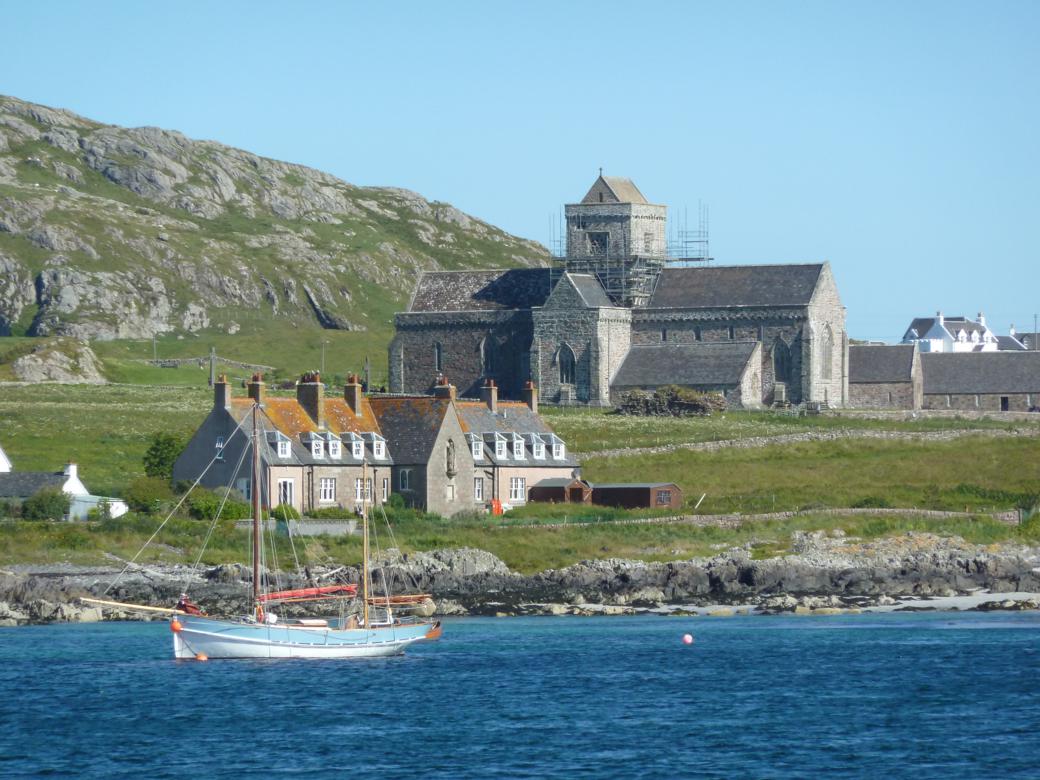
A view of the Iona Abbey from the bay
Recently a couple of people have asked me for advice on traveling to Iona. I remember feeling a bit lost the first time I went, and couldn’t find a go-to page with information (aside from the Iona website itself, which is good but not exhaustive, especially if you’re traveling from the U.S.).
So here’s a draft guide to traveling to Iona, an expanded version of an email I sent to one of these friends. I know many of you have been there and have even more experience than I do, so please pipe up with items to add, and we’ll make this guide better and better! (Be sure to check out the stuff in bold italic.)
What is Iona?
Iona is an island in the inner Hebrides of Scotland, and is said to be Christianity’s first outpost in Scotland back in the sixth century or so. The Iona Community is an inclusive Christian community that hosts pilgrims on the island throughout the year.
The Iona Community hosts folks in one of two facilities: the Abbey, mainly for adults, and Macleod (pronounced mack-CLOUD) Centre, mainly for families. There’s also Camas, but that’s off-island and for young people—not the focus of this post.
The Iona Community doesn’t bill itself as a conference center or a retreat center, though it has elements of both. It is an experience of living in community. If you stay in Iona Community accommodations, you won’t have a private room (though if you travel with someone you can room with them, and families are kept together in Macleod’s large rooms). Also, bathrooms are down the hall, with sinks in the bedrooms. The accommodations are perfectly serviceable and comfortable but not fancy.
As part of the community, you’ll be divided into work groups and given tasks to do each day. These are minor, like setting tables for meals, sweeping, chopping vegetables, or cleaning bathrooms. Meals are family style and the different task teams serve those. Tasks take 20 minutes each day, tops, and are nice for building community and doing your part.
What is a week at Iona like?
The Iona Community’s week-long program begins with an arrival Saturday afternoon and ends with a Friday morning departure. Some weeks are programmed, with a speaker who leads things in the morning, with afternoons free. Check Iona Community’s website to see what they have planned each week. I’ve been to a programmed week and an open week and I prefer the latter. That said, the programmed weeks provide plenty of free time, and the open weeks typically have scheduled activities, such as tours of the facilities, hymn sings, and other options. Worship takes place each evening, with different themes each day.
The pilgrimage is the highlight for many people. It’s a multi-hour trek around the island to view the various sacred sites. There’s an off-road version for hardier souls and on-road for people who want a shorter experience. The off-road version is subject to be altered or canceled based on trail conditions, and they are insistent on proper footwear—waterproof shoes, ideally hiking boots with ankle support.
Which pilgrimage should you choose? I highly recommend the off-road version, provided that:
-you’re in good enough shape
-for a 5-hour hike with frequent stops (including almost an hour for lunch)
-on uneven (but not mountainous) terrain.
The pilgrimage is usually on Tuesdays.
There’s also an evening of folk dancing, called a Ceilidh (pronounced KAY-lee), in the town hall. It’s fun and intergenerational. Think Celtic line dancing.
If you stay in the Macleod Centre you also have access to their beautiful and amazingly-stocked craft room. Many happy hours can be spent there.
What about island activities?
Here are a few fun things to do beyond the walls of the Iona Community. (Iona is great for wandering, so get yourself a map of the island from one of the shops.)
- Have a cream tea at one of the inns and hotels and/or book a lunch or dinner.
- Climb up Dun I (pronounced dun ee), the highest point on the island at a manageable 331 feet.
- Have a drink and enjoy the view at Martyr’s Bay restaurant.
- Visit the beaches and wade in the clear but coooooold water.
- Book a boat trip to nearby Staffa to see Fingal’s cave and, if the timing is right, PUFFINS!
Note: I have never done this because the boat is small and the seas are rough. Bad combo for me. - Browse the shops for souvenirs, folk crafts, wool (aka yarn), or an ice cream sandwich.
- Stargazing, meandering walks… anything you’d do in a wild rural setting.
Where do I start with logistics?
As of this post, the Iona Community has not yet posted its schedule for next summer. When they do, it should be here. First step is to decide when you want to go and fill out a booking form (also available at that link). Once you are confirmed, you can investigate flights and other travel arrangements (see below).
What if I want to go on my own, not as part of the Community?
I don’t have a lot of logistical information to offer on that. Go to Isle of Iona’s website and poke around for accommodations and information.
If you go on your own, you’re always welcome to worship with the Community in the Abbey Church-services are daily-and the pilgrimage is also open to all, as well as the Ceilidh. Those events are in the early part of the week, so plan accordingly.
What do I need to know about traveling there and back?
If you can manage it, I’d get to the UK a few days before you head to Iona. This allows you to get over your jetlag. And IF heaven forbid you lose your bags, which happened to people in our group the first time, it gives you time to be reunited with your luggage before getting to the island.
Americans: Our family flew into Dublin a few days early and saw the sights there, then flew to Glasgow. Dublin is a great airport because when you return to the U.S., you do all the customs and immigration at the Dublin airport before you leave. So when you get to your home airport you just collect your bags and head home. Highly recommended.
Whatever you decide to do, you need to be in Glasgow by Friday night so you can start the journey to Iona first thing Saturday morning.
There is information on the Iona website about travel from Glasgow and back. It involves a 3 hour train ride, a 45 minute ferry ride, an hourlong bus ride, and a five minute ferry. This sounds very complicated but it’s quite easy, especially in the summer. If you leave Queen St. Station in Glasgow on the 8 a.m. train you pretty much can’t go wrong. They’re set up for pilgrims to come to Iona. Just follow the crowds.
Breaking down the steps, you need tickets for:
- The train from Glasgow to Oban. Buy ahead of time so you’re not rushed that morning. Using the Rail and Sail site to get both train and Oban ferry tickets.
- The ferry from Oban to Craignure on the island of Mull. Buy these the day of at the terminal on the dock, or see previous note.
- The bus ride across Mull. Buy them the day of. Seriously. They’re lined up right next to the dock. I can’t remember if they accept credit cards or cash only, but it’s £11 round trip, so bring enough cash just in case.
- The ferry ride from Fionnphort (pronounced FIN-eh-for, best I can tell) to Iona. Same disclaimer about cash/credit, and I can’t find the price, but it’s less than the bus ride.
How about going with children?
Traveling to Iona with one’s family is obviously a huge expense, but for us it was worth the saving up and the effort. Sadly, some communities welcome children more in theory than in practice, but Iona really takes hospitality seriously, including for little ones. The Macleod Centre is a comfortable, accommodating place for children. (Remember, they’ve got that amazing craft room.)
I was curious to see how our plugged-in, chicken-nugget-eating American kids would do in a remote location with no Internet and unfamiliar food. (Iona serves mainly vegetarian options, and they’re good about accommodating allergies and sensitivities.) I’m sure our kids ate more than their share of bread that week, but they were none the worse for wear. And they really “got” the place, and enjoyed getting to know people from other countries. You know your own children and your budget, but I encourage you to give it a try if you can.
What about packing?
- Pack light and plan to handwash items in your sink. There is a drying room in the Abbey and Macleod, and while it’s better than nothing, it mainly succeeded at giving our supposedly clean clothes a slight mildewy smell.
- Layers and good footwear, preferably boots.
- You do not need any dressy clothing while there. Worship is casual.
- There are some boots and waterproofs that can be borrowed, but I’d bring your own.
- Make sure you’ve got one of these outlet adapters if you bring electronics.
- If you get carsick easily, bring Dramamine for the bus ride across Mull. It’s a single lane road so there’s a lot of pulling over to let other traffic pass.
- Friends: what else should be added here?
Miscellaneous
- There is no Internet access in the Iona Community’s centers. You can access WiFi at one of the nearby hotels for a small fee.
- You can eat at the cafe on the ferry from Oban to Mull, but do yourself a favor and stop at the seafood shack for some prawn sandwiches instead. Get ‘em to go and bring ‘em on board. Nothing fancy, but fresh as can be.
- Then when you get back to Oban on your return, stop by the George Street Fish and Chips shop for some piping hot takeaway (cash only).
Have you been to Iona? What have I left out?
~
P.S. Email newsletter will be sent soon. Sign up.