Tag Archives: religion

Penn Jillette: Atheists Need Holidays Too (Bonus Link Love)

Tomorrow’s Friday Link Love will feature a discussion on the New York Times about whether atheism is a religion. As a setup to that, Penn Jillette has a book out called Every Day is An Atheist Holiday! Here’s an excerpt, posted on Brain Pickings:

In Alice in Wonderland, Lewis Carroll invents the idea of the un-birthday. If we celebrated those we’d have 364 more (in a leap year) un-birthdays than birthdays. Atheists have always had the corner on un-holidays. Christmas, Easter, Good Friday, Ramadan, Rosh Hashanah, the day Tom Cruise had sex with a woman are all holidays in some religion but they’re never a celebration of life. The joy is the exception that proves the rules. It’s the celebration of a joy that we don’t have.

The word ‘holiday’ comes from ‘holy day’ and holy means ‘exalted and worthy of complete devotion.’ By that definition, all days are holy. Life is holy. Atheists have joy every day of the year, every holy day. We have the wonder and glory of life. We have joy in the world before the lord is come. We’re not going for the promise of life after death; we’re celebrating life before death. The smiles of children. The screaming, the bitching, the horrific whining of one’s own children. … Sunsets, rock and roll, bebop, Jell-O, stinky cheese, and offensive jokes.

For atheists, everything in the world is enough and every day is holy. Every day is an atheist holiday. It’s a day that we’re alive.

Once again Jillette lumps religion into the same tired heap of deferred-gratification, sweet by-and-by that bears little resemblance to religion as it’s lived by many, many, many people. Even Christians for whom praying the sinners’ prayer gets you a ticket to heaven are working to fight poverty, human trafficking, and even climate change. But that’s not my point.

Further, the idea that atheists are people who are full of joy and mirth is so over the top as to not warrant much comment. I find them to be just as dour and road-ragey as the rest of us. Except Buddhists. You get the feeling those folks don’t ever drive angry.

Instead, I want to highlight the importance of holidays, for atheists and for everyone.

Of course every day is a gift to be celebrated, whether you are a Christian, a Baha’i, a Pastafarian, or a member of the Church of Christopher Hitchens of Latter-Day Drunks. No less than Abraham Joshua Heschel pointed out that in the Jewish/Christian creation tale, God creates the stuff of the universe and calls it all good, but when he creates the Sabbath he calls it holy.

Things are good. Time is holy. Jillette is absolutely right. We have the wonder and glory of life, right now. We need not wait until Christmas or Easter to revel in it.

But the problem is, that kind of wide-eyed wonder is simply not sustainable 365 days of the year. I’m not even sure it would be desirable. Human beings need seasons. We need rhythms and days and times set apart. OK, maybe need is a little strong. But psychologically speaking, holidays are healthy. They serve a worthy purpose.

I respect the heck out of Alain de Botton, atheist philosopher, partly because he approaches both his atheism and the religious life with humility and curiosity. He understands the utility of many aspects of the religious life, including days and seasons for specific purposes. Take it away:

Ms. Tippett: And, I mean, it’s interesting, a couple of other things that you — features of — very religious features of traditions that you also say that atheists and secular society could learn from, like the Day of Atonement in Judaism or the tradition of saints in Roman Catholicism.

Mr. de Botton: Yes. I mean, taking those two, the Day of Atonement, a fascinating moment in the calendar in Judaism where people essentially say sorry to each other and they say sorry against the backdrop of a God who doesn’t make mistakes, but humans who do. You are given license, encouragement, structure to do something which would be mightily hard if you were left to do it on your own like, as I say, saying sorry. It’s much easier to say sorry if everybody is doing it on a particular day because then there’s a sort of cycle of mutual apology and forgiveness which makes the whole thing much more normal. We’re very suspicious of ritual in the nonbelieving world. You know, we think that there shouldn’t really be rituals, that the private life should have its own rhythms and that no one should come in from the outside and say, you know, today we’re going to say sorry and next week we’re going to worship spring and the day after we’re going to think about the qualities of humility in a saint or something. The idea is you should do all this on your own in private. I’m coming around to the view that that’s nice in theory, but the problem is we’ll never get ’round to it.

As someone who practices, thinks about, and writes about Sabbath, let me humbly suggest to Jillette and other atheists that you not let go of holidays. I’ll leave it to you to discern what those might be—and you could have big fun with this by coming up with your own, or just co-opting the religious ones. (We did it first, and turnabout is fair play.)

But this wonderful life that we all live in different ways? Is also a life filled with commutes and grocery lists and sciatica. It gets away from us, all too easily, if we don’t take time to savor it. Holidays help us do that.
Friday Link Love: Flying Houses, Being a Mystic, and Mighty Girls… One of Whom with Toilet Covers on Her Head

First, if you haven’t already heard me shouting from the rooftops about it, here is my interview about Sabbath in the Suburbs on Huffington Post Books.

Another note. I share links to interesting, inspiring, curious content all week long at my Facebook page. Feel free to subscribe to the public updates, even if we’re not FB friends!

Lots of images in Link Love this week, and a few meaty quotes. Onward…

~

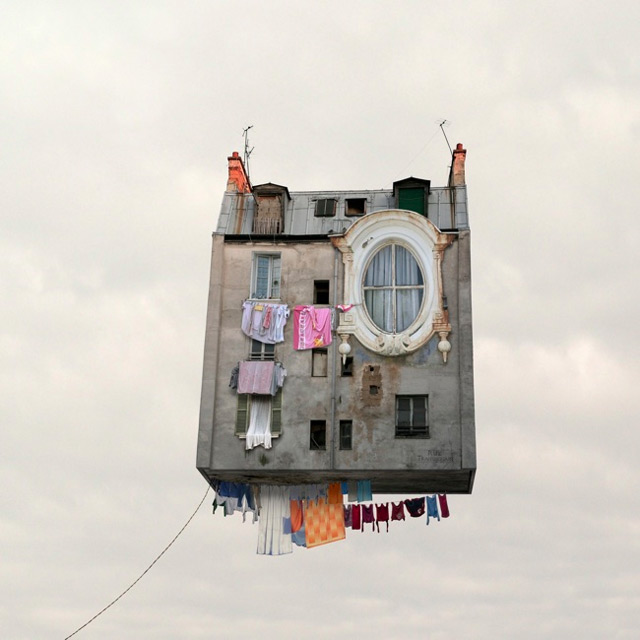
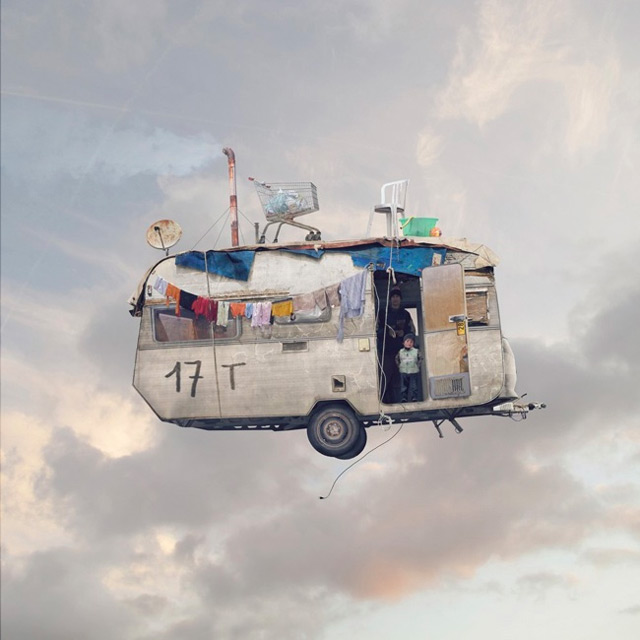
Flying Houses by Laurent Cherere - Colossal

Wonderful. Like something out of Roald Dahl:

laurent-2

laurent-4

~

Top Read-Aloud Books Starring Mighty Girls — A Mighty Girl

This is one I shared on Facebook. Great list! I want to read them all.

~

Christian Wiman on Faith and Language — Andrew Sullivan

Another one I shared earlier this week, but dang, I like it:

To have faith in a religion, any religion, is to accept at some primary level that its particular language of words and symbols says something true about reality. This doesn’t mean that the words and symbols are reality (that’s fundamentalism), nor that you will ever master those words and symbols well enough to regard reality as some fixed thing. What it does mean, though, is that you can ‘no more be religious in general than [you] can speak language in general’ (George Lindbeck), and that the only way to deepen your knowledge and experience of ultimate divinity is to deepen your knowledge and experience of the all-too-temporal symbols and language of a particular religion. Lindbeck would go so far as to say that your religion of origin has such a bone-deep hold on you that, as with a native language, it’s your only hope for true religious fluency. I wouldn’t go that far, but I would say that one has to submit to symbols and language that may be inadequate in order to have those inadequacies transcended.

This is true of poetry, too: I don’t think you can spend your whole life questioning whether language can represent reality. At some point, you have to believe that the inadequacies of words you use will be transcended by the faith with which you use them. You have to believe that poetry has some reach into reality itself, or you have to go silent. - Christian Wiman, “Notes on Poetry and Religion,” from Ambition and Survival: Becoming a Poet.

~

Stoic, Addict, Mystic - Andrew Sullivan

Another one posted on The Dish this week:

We are rarely presented with an authentically fulfilling trajectory for our desires… If we are created for infinite satisfaction, we really only have three choices about what to do with our desire in this life: We will become either a stoic, an addict, or a mystic. The stoic squelches desire out of fear, while the addict attempts to satisfy his desire for infinity with finite things, which, of course, can’t satisfy. That’s why the addict wants more and more and more. The mystic, on the other hand — in the Christian sense of the term — is the one who is learning how to direct his desire for infinity toward infinity,” - Christopher West, whose new book is Fill These Hearts.

For infinity, toward infinity. Nice.

~

Winners of the 2012 National Geographic Photo Contest — National Geographic

A cat picture won! Sort of. Go to the link to see the grand prize winner, as well as all the other top picks. My favorite in the “people” category:

~

Unleash Your Unconscious: How Switching Tasks Maximizes Creative Thinking — 99U

Incubation breaks boosted creative performance, but only when the time was spent engaged in a different kind of mental activity. Participants who in the break switched from verbal to spatial, or from spatial to verbal, excelled when they returned to their main task – in terms of the number and quality of their solutions. The change in focus freed up their unconscious to spend the incubation period tackling the main challenge.

Highly recommend running, for people with the knees for it.

~

Embracing Mystery in the New Year: Ten Essential Practices — Christian Valters Paintner

Follow the thread. Each of us has a unique unfolding story and call in this world. We don’t “figure this out” but rather we allow the story to emerge in its own time, tending the symbols and synchronicities that guide us along.
Trust in what you love. Following the thread is essentially about cultivating a deep trust in what you love. What are the things that make your heart beat loudly, no matter how at odds they feel with your current life (and perhaps especially so)? Make some room this year to honor what brings you alive.

~

Airplane Lavatory Self-Portraits - Sad and Useless

h/t Keith Snyder.

Nina Katchadourian whiles away long plane journeys by locking herself in the lavatory and pretending to be a 15th century Dutch painting. The project began spontaneously on a flight in March 2010 and is ongoing…

I do think about the line forming outside the door while she’s doing this, but:

lav3

~

Have a wonderful weekend!

Friday Link Love

The Cult of Collaboration — Fernando Gros

Just jokin'. Sort of.

…We often need to collaborate in order to solve really big problems. And, as humans, we also need to work alongside other people to satisfy more basic emotional desires for community and belonging.

But, the hard slog of creating, innovating and thinking is something we largely do alone.

That’s something I totally agree with. And, it worries me that in many parts of society, including schools, we are not encouraging people to develop the skills required to work alone, for extended periods of time, on complex problems.

Add in the fact that smartphones mean that we need never be alone again, and this is an issue worth thinking about. Alone. Or together.

~

Religion for Atheists — Alain de Botton

We are far more desperate than secular modernity recognises. All of us are on the edge of panic and terror pretty much all the time – and religions recognise this. We need to build a similar awareness into secular structures.
Religions are fascinating because they are giant machines for making ideas vivid and real in people’s lives: ideas about goodness, about death, family, community etc. Nowadays, we tend to believe that the people who make ideas vivid are artists and cultural figures, but this is such a small, individual response to a massive set of problems. So I am deeply interested in the way that religions are in the end institutions, giant machines, organisations, directed to managing our inner life. There is nothing like this in the secular world, and this seems a huge pity.

The above link is to an FAQ about Botton’s TED talk on Atheism 2.0, which is outstanding and available here.

~

Pomodoro Technique

If you’re not familiar with the pomodoro technique for time management, it’s incredibly simple and very effective. I wrote Sabbath in the Suburbs primarily using techniques like this one.

Poke around the website to learn more about it, though for heaven’s sake, I don’t know why you’d need a $26 book to understand it, let alone the tomato-shaped timer, although it is cute.

~

And along the lines of time management:

The Biggest Myth in Time Management — Harvard Business Review

In a nutshell: That we can get it all done. (Comments are interesting, trying to diagnose “Brad’s” problem in the article.)

I think this simple realization has profound spiritual implications, way beyond simple time management. But then again, I would think that, I just wrote a book about Sabbath…

Have a good weekend. It’s a long weekend for us, what with teacher work days on Monday and Tuesday. We have our congregation’s annual meeting on Sunday, after which the kids and I head to Johnstown, Pennsylvania for a short visit with Robert’s grandmother.

Friday Link Love

Here we go:

~

See-Through Church - Belgium

I ran across this on Andrew Sullivan’s blog, who said, “that’s one way to get more transparency in the church.” Visually arresting; see the link for more photos:

~

Applying Sentiment Analysis to the Bible - OpenBible

An interesting image and idea, and something one could sit and study for quite some time… although I notice that the resurrection is listed as a negative event. Yeah, I guess Mark could be read that way…


~

The Roots of Religion - Big Questions Online

Myth, story, practice…

I have found that the very mention of the words “religion” and “evolution” sets off a kind of reflex reaction among some, but fortunately not all, contemporary Americans. Among both religious fundamentalists and what might be called atheistic fundamentalists these terms set off a war to the death, with abusive language directed toward the supposed opposition. In that kind of atmosphere any rational discussion becomes impossible. What unites these two groups is the idea that religion and science are essentially the same thing: sets of propositional truths that can be judged in terms of argument and evidence.

What surprised me when I began to read the work of leading scientists in the fields of cosmology and evolution is how many of them rejected this idea and argued instead that science and religion are really two different spheres that may at points overlap but that operate in accordance with different logics. Science operates with scientific method in terms of which different theories can be tested and proved or disproved, though if Karl Popper is right, proof is always problematic and we are safer to stick to disproof. Religion on the other hand is a way of life more than a theory. It is based on beliefs that science can neither prove nor disprove. Its “proof” is the kind of person the religious way of life produces.

~

Dying and Dinner Parties - Vimeo

Linked from the Improvised Life blog, this is a delightfully matter-of-fact take on the last adventure of life.

Dying and Dinner Parties from ThinPlace Pictures on Vimeo.

~

An Interview with David Eagleman - BoingBoing

David and I were at Rice University at the same time, though I did not know him there. He’s made the rounds on some of my favorite podcasts, including Radiolab, and his book Sum: Forty Tales of the Afterlives is really interesting. In this interview he tackles near-death experiences, déjà vu and more. When asked what advice he’d have for young aspiring scientists and thinkers, he says:

Watch TED talks: smart people will distill their life’s work down to 20 minutes for you. Follow links through infinite trajectories of Wikipedia. Watch educational videos on topics that resonate with you.

There are a million ways to waste time on the net; reject those in favor of ways that teach you exactly what you want to know. Never before have we enjoyed such an opportunity for tailored, individualized education.

And be sure to get off-line often, to take digital sabbaths. As much as the net provides a platter of mankind’s learning, there is a different kind of learning to be had from a hike in the woods, the climbing of a tree, an afternoon building a dam in a stream.

Amen!