Tag Archives: running

Monday Runday: My Life as a Centaur

Several weeks ago I received this note via Facebook Messenger:

Hey MaryAnn, I have a question/offer for you. A while back I won 3 free sessions on an AlterG treadmill. I have been following the journey of your stress fracture healing and I want to give you the sessions.

This was from a member of Springfield Moms RUN This Town, someone I knew but not super well. (You can see why I still claim membership in that group, even though I moved from Springfield. They’re a special bunch of ladies. Although I look forward to getting to know my local chapter too.)

I got this message on a day when I was feeling particularly low about my injury. So after I finished laughing and crying at the sweetness of this offer, we got the logistics worked out. I’ve now had one of the three sessions at Capitol Rehab in Annandale with Dr. Compas.

The AlterG is based on technology designed to help astronauts work out in zero gravity, but here on earth it works in reverse—you can adjust the treadmill so that the patient runs on a set percentage of their body weight. This is a great thing for people who are coming back from injury and are easing back into weight-bearing exercise. And, it’s a total trip.

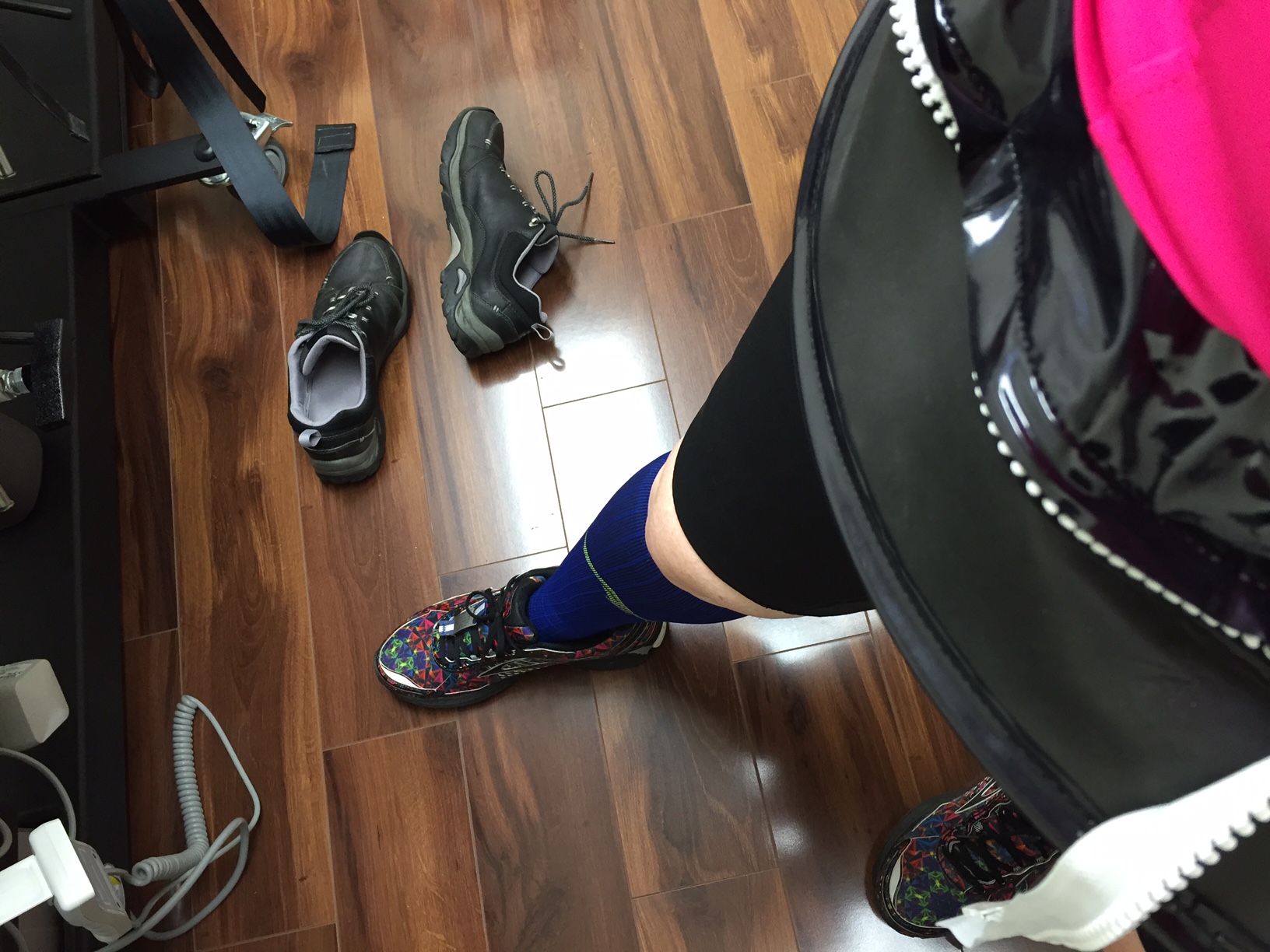
Basically you put on these super-tight bicycle shorts, with a zipper around the middle:
IMG_8581

Then you step onto the treadmill and are zipped in. The bottom half of you and the treadmill belt are encased in a large bag that inflates and deflates based on the percentage you select. Last week I did most of my run at 50% of my body weight:

IMG_8576

The title of this post comes from my friend Paurenia, who saw this picture and said I “looked like a sexy centaur.” Ha!

I’ve been running on the roads a little bit, but it’s been for very short distances and I’ve had to be very cautious about it. With the AlterG I was able to run for more than 30 minutes, pain free!

The sensation takes a little getting used to-you definitely feel lighter on your feet, though the zipper keeps you hemmed in so you can’t really fall like on a regular treadmill. It’s a great transition from pool running, in which you’re completely buoyant, to road running, in which you’re pounding pavement. And because you’re running on less weight, you can go a lot faster than you normally do, which is a lot of fun.

I also want to say a good word for Dr. Compas and his staff at Capitol Rehab. He is an athlete himself and “gets it”; plus he’s competent and compassionate. He helped me understand the source of my injury so I can avoid it next time. I haven’t used him for chiropractic care but I have friends who have and they like him a lot.

Happy running/walking/living…

Monday Runday: “Retuning” to Running

Returning to Running following an Injury

And I’m finally back to it.

Last Wednesday morning, I got up veeeeeeeeeery early to drive down to Springfield to run with a bunch of my 5 a.m. mama runners. I knew I wanted to be with them for my first run back. They’ve been such treasured friends over the past year, I knew I wanted to celebrate my return from injury with them.

And if it didn’t go well-if the stress fracture site flared up-well, I’d need them there for Mental Health Watch.

It’s been a long 12 weeks.

Thankfully, everything went fine and I’ve run twice since then. Half a mile each time, plus about a mile of walking, with a day of rest in between each workout.

I’ve got all this pent-up energy (and I’m soooo sick of the pool and the bike) that I want to go full-out. I’m eager to get back to my previous fitness level. It’s humbling to go from 120 miles a month to maybe 10.

Plus the fall has been gorgeous.

Returning to Running Following Injury

View from my back patio

IMG_8562

Returning to Running Following Injury

When I was researching how to train safely following a stress fracture, I ran across an article with a typo in the title. It should have said “returning to running” but it said “retuning.” That seemed right though. Like a musical instrument that’s fallen out of tune, or a car in need of some TLC.

In theory, the body mends a stress fracture stronger than before. Assuming you’re healed, you shouldn’t get re-injured in the same spot. But the rest of the body compensates for the hurt place, and that can cause its own problems. Whatever precipitated your injury in the first place needs to be tended to as well.

So I’m returning, and retuning. For me that means continuing to cross train, incorporating more strength work, and at least for now, not running more than three days a week.

What are you retuning these days?

Monday Runday: You Can Do This Hard Thing

[Yes, I’m a day late posting this. But Tuesday Runday doesn’t have the same poetry.]

Back in May I attended a concert with one of my favorite singer-songwriters, Carrie Newcomer. She sang a new song that was inspired by her (now grown) daughter, who attended a Montessori school. When the children were getting ready to do something new that was going to be a stretch for them, the teachers would say, “You can do this hard thing.” This phrase acknowledged both that the task was difficult and that everything they’d previously done had prepared them for it.

I shared this phrase with my Moms RUN This Town group after the concert, and I’ve been happy to see it take on a life of its own. As group members set goals, run marathons and come back from injury, people are now reminding one another “you can do this hard thing.”

Here’s a video of the song. It’s not a pump-you-up running tune, but the message is still there.

Tomorrow morning I will run 1/2 mile, the longest distance I’ve run in 12 weeks. If all goes well, I’ll continue running that short distance every other day, then gradually, oh so gradually, increase the distance. (If it doesn’t go well, we’re gonna need to go on MaryAnn Mental Health Watch, because enough already.)

It will be a hard thing. But I can do it. And let’s face it, there are harder things out there, which is important perspective too.

I loved this story from this weekend’s New York City Marathon:

Kyle and Brent Pease have completed two 140.6-mile Ironman events together, so they felt more than ready for the New York City Marathon on Nov. 1. Of course, this was before the right rear wheel on Kyle’s wheelchair broke into pieces after the 12-mile mark.

Kyle Pease has cerebral palsy, and the brothers have been competing in racing events for several years now.

Brent carried Kyle for about a half mile before he realized that wasn’t going to work. Then the NYPD escorted them to a nearby bike shop, but they weren’t able to come up with a good solution. And then:

A fellow runner named Amy noticed the brothers struggling with steering, so she joined Brent’s side and steadied the chair as he pushed it forward. Shortly after that another runner named Cameron joined the team and helped stabilize the other side of the chair.

Image courtesy of Amanda Gordon / The Kyle Pease Foundation

“The three of us shouldered the weight and helped cover the remaining miles together,” Brent said.

Fierce.

To find out more about their foundation, click here. And go do a hard thing today.

Monday Runday: Volunteering at the #BlueMile

Once it was clear that I was no longer running the Marine Corps Marathon, I knew I wanted to do something special on the day besides just spectate. (I should put “just” in quotes because crowd support is so important and motivating and is part of what makes races so much fun, but still.)

When I heard from the mama runners at Springfield MRTT that wear blue: run to remember still needed lots of volunteers for the blue mile, I knew it was what I wanted to do. wear blue sponsors the blue mile at many major races and all of the big military ones, and it packs a powerful emotional punch. wear blue chapters also sponsor group runs that begin with a circle of remembrance, in which people call out the names of servicemen and women they’re remembering and running for. I’ve been to two wear blue events and both were large, and still, every name was heard.

One of the goals of wear blue is to “bridge the gap between military and civilian communities.” I guess I’m symbolic of that bridge because I didn’t grow up in a military family. My brother spent four years in the Marines (and ran MCM this year!) but he’s really the only one. When I moved to Northern Virginia and began serving a church with a large population of military folks, that was my first experience in that community and understanding what they go through.

I’ve run in races that had a blue mile. Many people I know find the courage to continue a tough race when they see those photos and those flags. At Rock n Roll DC, the blue mile goes up the hardest hill, and many friends say that inspiration pushes them up. They run for the fallen who can’t.

For me it’s the opposite. The blue mile takes my breath away. It wrecks me. Such a loss of honor and youth and talent. I stop short of being an all-out pacifist, but I’m a bleeding heart down deep.

But guess what? So are many military families I know. And few people can understand the full cost of war like a family member who’s holding a flag with the name of their lost loved one on it.

~

Caroline volunteered early in the week to join me, but Margaret stayed on the fence until the day before, when she signed on too. Even so, at the 4:30 a.m. wakeup call she was just too tired… “but I might as well go to the bathroom since I’m awake.” I said that was fine, but I knew she’d decide to go for it and sure enough, she came downstairs soon after, dressed and ready to go.

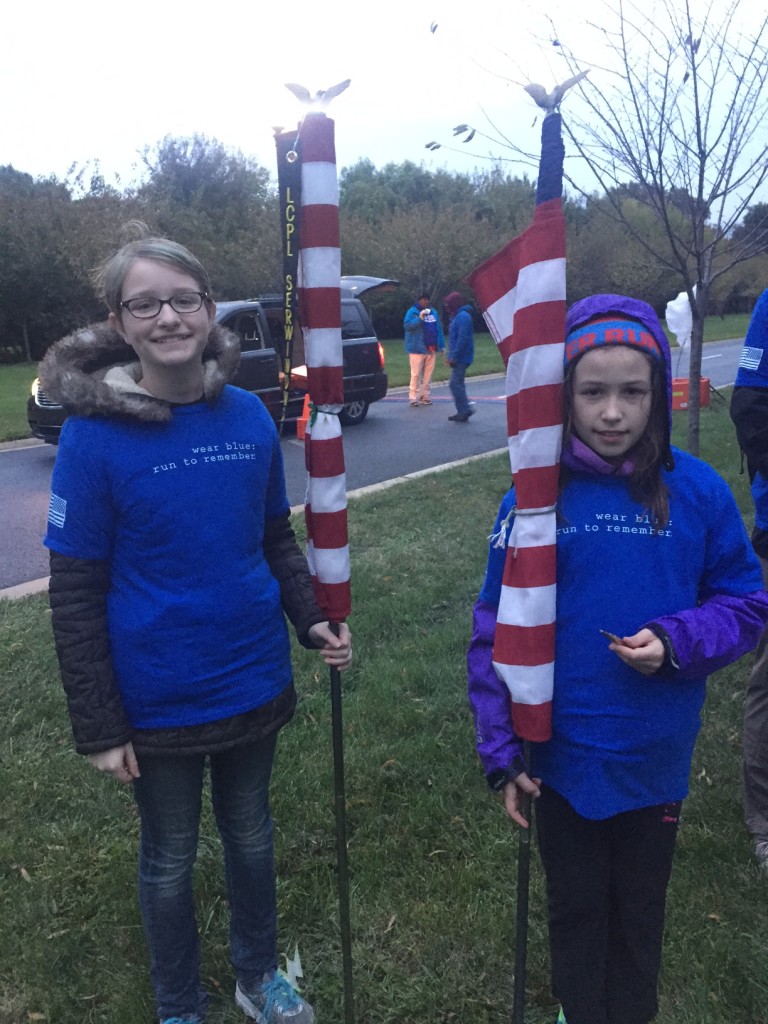
We reported to the volunteer site, mile 12 on Hains Point. After a checkin and brief instructions we received our flags:

IMG_8498

Since Matthew was in the Marines, we chose two lance corporals, LCpl Daniel Deyarmin Jr. and LCpl Timothy Serwinowski. I texted the names to my brother who said “I shall run for them.”

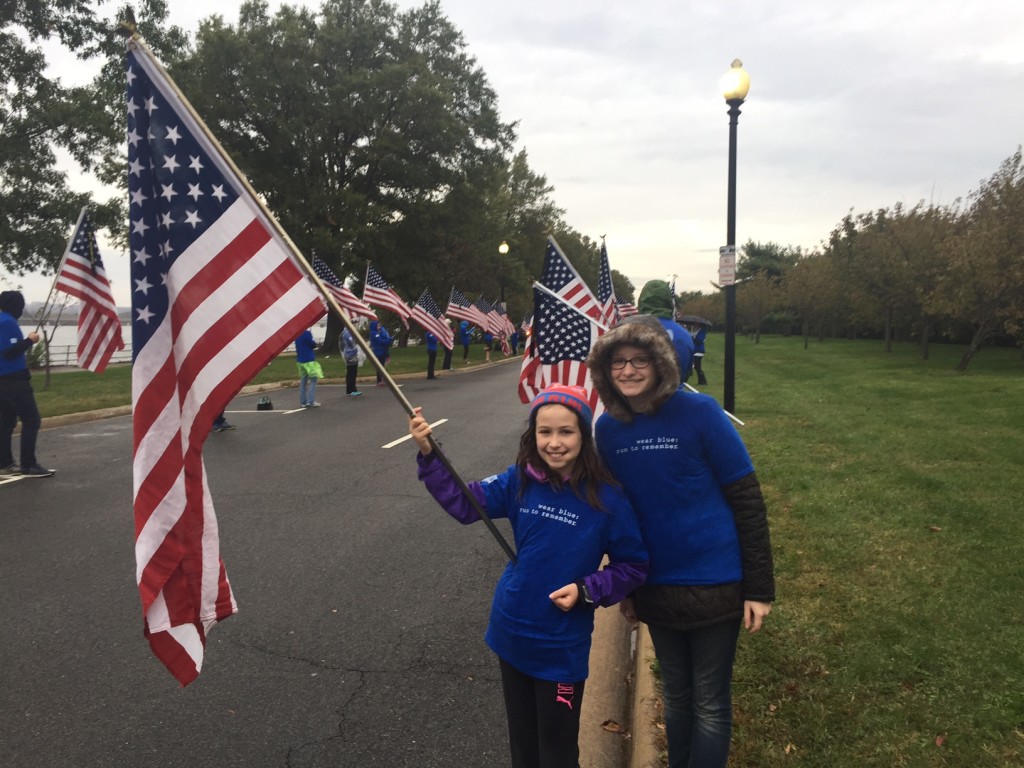
After the circle of remembrance, we lined up. The blue mile consists of a series of photos of the fallen:

And then a series of flags, each bearing a black ribbon with a servicemember’s name. I heard someone say they keep the photos separate from the flags because the photos are so somber. It is a reflective way to enter the mile. People can be seen looking for a specific photo or touching each picture, often with tears on their faces.

After the photos is the line of flags. It’s good these are separated from the photos because this part manages to be reverent and raucous at the same time, as flag-bearers cheer loudly for the runners as they come through.

IMG_8505

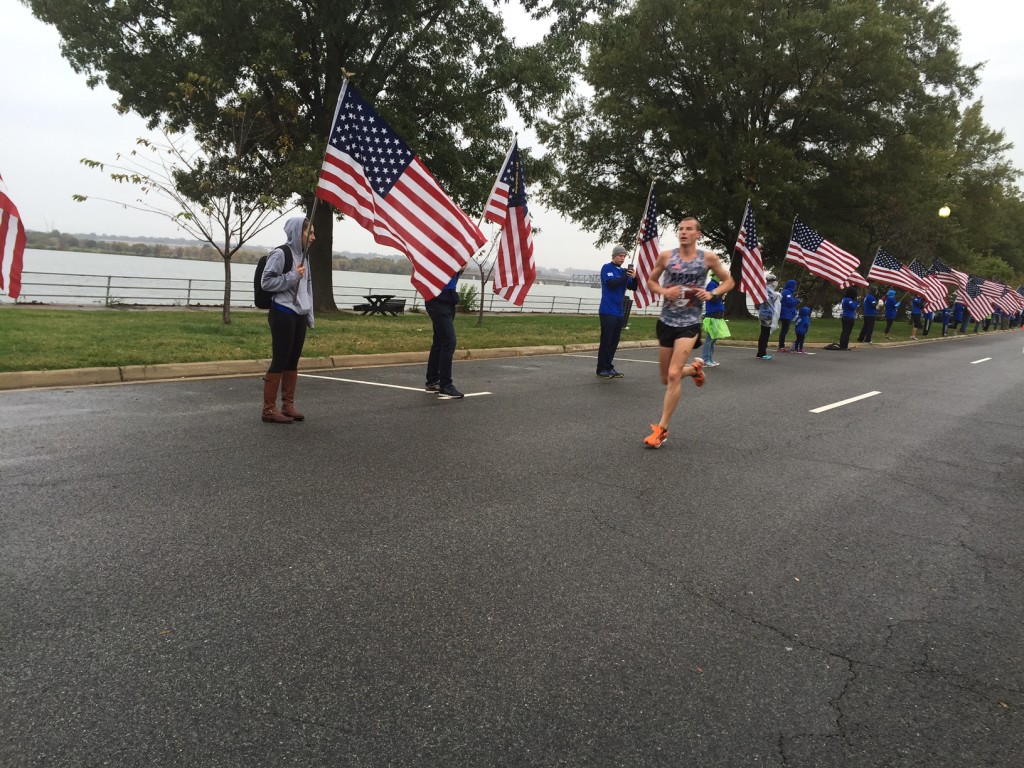
And boy did they come through, 30,000 of them over several hours, beginning with the hand-cyclists. Amazing:

IMG_8504

And here comes the first runner through the mile, though he ended up not being the one who won.

IMG_8515

One of the hidden benefits of being at the blue mile is that you see everyone pass by, from the fastest runners to the most determined walkers, who are eyeing the sweep buses and often nursing injuries. But also, friends who were running knew exactly where to look to find me. I gave lots of hugs and high fives to friends who were giving their best on those streets.

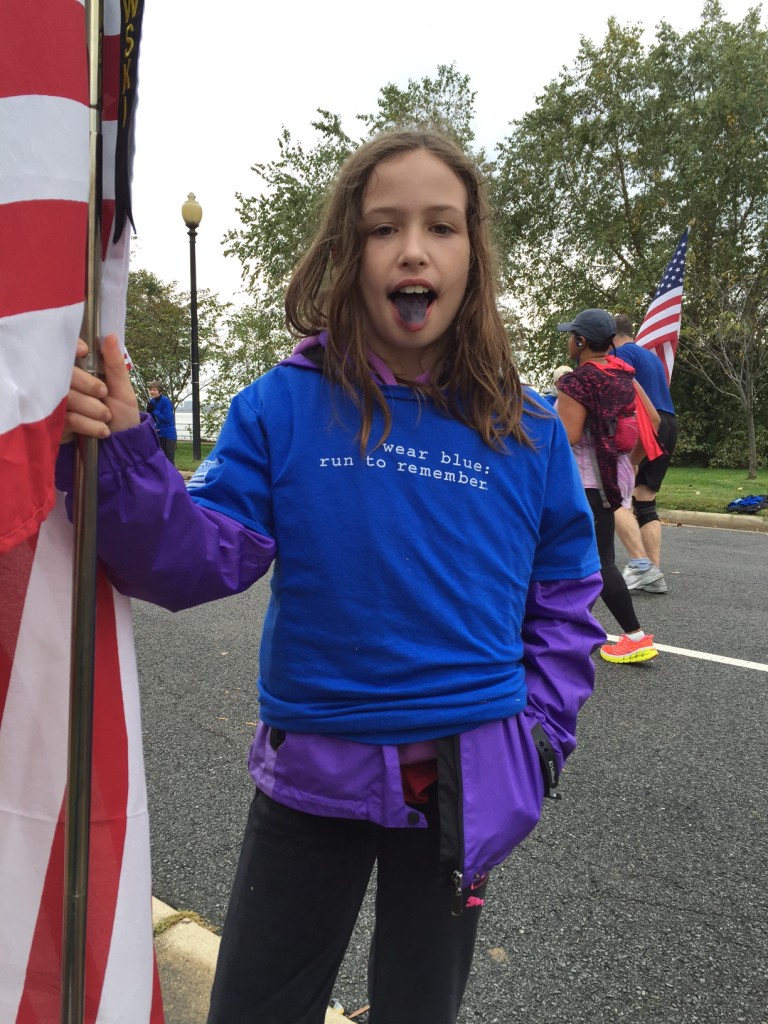
The girls and I also had Jolly Ranchers in case people needed a little something for parched throats, but we ended up eating most of them:

IMG_8518

Blue tongue aside, every time we passed the photos Margaret would say “There are so many of them.” I think she was glad she participated, but she was one-and-done. The earliness of the hour was hard, but really I think it touched her emotionally.

IMG_8500

I’m happy I volunteered. It was humbling to be thanked for it, which many runners did. It was an honor to be there.

IMG_8519

Learn more about wear blue: run to remember.


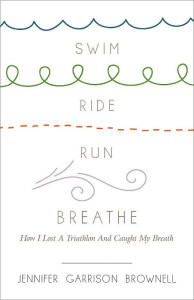
Now Read This: Swim Ride Run Breathe: How I Lost a Triathlon and Caught My Breath

Swim Ride Run BreatheI’ve been excited for a while about Jennifer Garrison Brownell’s book Swim Bike Run Breathe: How I Lost a Triathlon and Caught My Breath. Jennifer is a member of that strange tribe many of us have: people we’ve known for years, but only online. As pastor/bloggers, we were both charter members of RevGalBlogPals, and she also was kind enough to visit some friends of mine who found themselves in the hospital out in Portland. I can always count on her for wit and wisdom wrapped up in a beautiful turn of phrase, and she provided abundantly in her book.

Triathlons have interested and scared me for years. As a recreational runner I have 33% of the puzzle, but the other two hurdles always seemed insurmountable. I get seasick in the pool-the POOL-without the right food in my stomach. And cycling? I have a heavy hybrid bike and a mental block about the intricacies of shifting. (Growing up in flat-as-a-pancake Houston, gears were for recreational purposes only.) I admired my tri friends but never seriously considered joining their ranks.

Then I got injured, and biking and swimming became my only options. I am learning to make friends with my gear shift. And I can swim more than a mile without dizziness if I scarf down some good protein beforehand.

Meanwhile, Jennifer kindly sent me her book when it came out. I’d intended to contact her and beg for an advanced review copy and never got around to it. But of course, it came at the right time, when I’d just begun to think “Maybe I could do a triathlon.” But you don’t need to be interested in that event, or even any of the three sub-sports, to be drawn to this book. Because the book is about love and family; it’s about our beautiful finite bodies in all their strength and limitation; it’s about where we feel alive and where we feel fear, and the intersections between them.

Jennifer’s book has three interconnected threads:

  • a memoir of growing up, marrying a “seriously disabled man” (her words-Jeff has a form of muscular dystrophy), caring for him, and raising a son with him
  • a reflection on training for her first sprint triathlon-moving from someone who was never an athlete to taking on the training and mental conditioning required to prepare for a race
  • the experience of the triathlon itself.

Part of what’s neat about a triathlon is how different the three sports are. Jennifer exploits these differences by dividing her book into Swim, Ride and Run, weaving in pieces of her story that are connected to the skills required for each. Swim touches on the grace required to move with fluidity and let the water carry you. Ride explores the effort involved in keeping the up and down motion going no matter what-and what it means to coast sometimes. And Run is a practice of pure endurance-but also joy, because the finish line is in sight!

I dog-eared a lot of this book, which is a high compliment. I will often underline and star passages in books, but sometimes when a book feels especially precious to me, I can’t bring myself to sully it with a pen. This is one of those books.

Thank you for your words, Jennifer! And thanks in part to your story, I’m doing this on Mother’s Day.